Petition, Public Meeting or Written Comment?
Choose a petition, public meeting or written comment that fits your civic goal, reaches the right decision-maker and follows the process rules.

Should you sign a petition, speak at a public meeting or send a written comment? Choosing between these civic participation options depends on what you want your contribution to do: show shared support, enter a discussion or explain a position in a record.
Start by checking who is making the decision, what stage the process has reached and which public input routes are open. The rules vary by body and process, so do not assume that a signature, spoken contribution or submission will trigger a particular response.
Use a petition to show shared support
A petition gathers people behind a shared request. Its central contribution is a visible expression of support for a specific action, such as asking a council to review a proposed change or urging a public body to retain a service. Signatures can show that others share the request, but they do not necessarily explain each person’s reasons.
Before signing, check who will receive the petition, what action it asks for and how its organisers say they will deliver it. Read the wording closely: your signature may imply agreement with the whole request, not just the concern that first caught your attention.
A petition may suit an issue that is easy to state and a request that supporters can share. Check whether the public body has a formal petition process with rules about wording, eligibility or what happens after submission. An online campaign may instead be intended to attract attention or organise supporters. Neither route should be assumed to trigger a debate or formal reply.
Choose a public meeting when discussion matters
A public meeting can help you hear an issue discussed and, where its rules allow, raise a point directly. It may be useful when local context matters, you have a question, or listening to other perspectives could clarify your position.
Check what kind of meeting it is. A council meeting, committee session, consultation event and informal community gathering can serve different purposes. Some allow public questions or statements; others are open to observers but reserve discussion to appointed members. An open door does not necessarily mean an open microphone.
Read the agenda and find the item relevant to you. Check whether you must register to speak, whether questions need to be submitted in advance and what rules apply to contributions. Prepare one main point and explain why it matters. If you have a question, direct it to the person or body able to address it.
Listen for points already covered. A brief contribution that responds to the discussion may add more than a prepared statement that repeats it. If you are not called on, the meeting can still help you identify who is responsible for the next decision and what remains unresolved.
A meeting may not suit a detailed argument that depends on documents or careful explanation. Ask whether there is a written route for supporting material or follow-up comments.
Send a written comment to explain your position
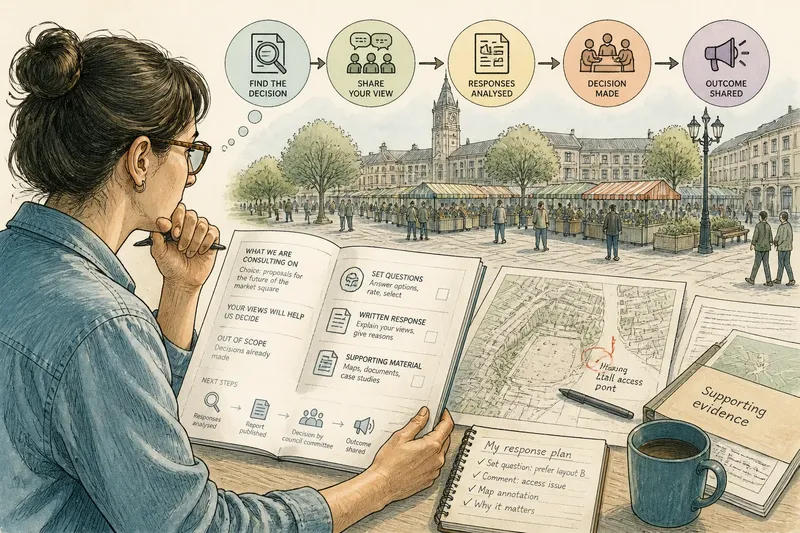
A written comment suits a point that needs explanation, detail or a clear connection to a proposal. State what you support or oppose, describe the specific issue and explain what you want the decision-maker to consider. Follow the organisation’s prompts so your comment addresses the matter under review.
Identify the correct recipient and check whether comments are being accepted. Look for the submission method, deadline, requested format and any questions respondents are asked to answer. A message to a general inbox may not reach the team handling the decision; if the route is unclear, ask the named office where to send it.
Keep the comment focused. Name the proposal or agenda item, state your position, give your main reasons and make a practical request. Distinguish what you know from what you are concerned may happen. If you refer to a map, policy document or local observation, identify it so the reader can follow your point.
Imagine a neighbourhood resident concerned that a proposed street change could make it harder to reach a nearby community centre. They identify the route, explain when access is a concern and ask the transport team to address that connection in its decision. The resulting comment gives the team a clear point to consider; it does not establish that the design will change.
Comments may be published or otherwise accessible under the process’s rules. Check its privacy information before including personal or sensitive details, and leave out information that is not needed to explain your point.
Match the channel to your civic participation goal
If your main point is that people share a straightforward request, a petition may fit. If you want to hear a discussion, ask a question or respond in the moment, check whether a public meeting allows that. If your view depends on reasons or supporting detail, a written comment can make them easier to review.
Check the process stage before choosing. A meeting may be for listening rather than deciding; a petition may arrive after a formal consultation has closed; a written comment may be accepted only during a designated response period. Read the notice or contact the responsible office if the purpose or route is unclear.
You can use more than one channel for different purposes rather than repeating the same message. For instance, you might attend a meeting to understand the discussion, then submit a concise comment that addresses what you learned. If you also sign a petition, check that its request matches your own position.
It is not worth sending the same long text through several channels without checking how each one works. A spoken contribution, signature and formal submission are received differently. Tailor your point to the route and add something useful.
What should you check before taking part?
How do you know which body is responsible?
Check the proposal notice, agenda or consultation page for the organisation making the decision. If responsibility is unclear, ask the named public office where comments or questions should go before taking part.
Can you speak at every public meeting?
No. Some meetings allow public questions or statements, while others permit observation but not public contributions. Check the agenda and speaking rules, including whether you need to register in advance.
Will a petition create a formal debate?
Not necessarily. A formal petition scheme may explain what happens after submission, while a campaign petition may simply present a request to its recipient. Read the stated process instead of assuming signatures trigger a particular response.
What makes a written comment useful?
Make it relevant to the proposal, explain your reasons in plain language and state what you want the decision-maker to consider. Follow the requested format and identify supporting material clearly.
Check the route before you contribute
Before signing, speaking or submitting a comment, check that your contribution names the issue, reaches the right recipient and fits the process rules. Ask whether you want to show shared support, add to a discussion or record a reasoned position. That choice helps you select a route suited to your purpose.
For a petition, public meeting or written comment, clarity matters more than choosing the most dramatic option. A well-matched contribution gives decision-makers a point they can understand and consider. Check the rules for your civic participation route once more before sending it, particularly if the notice names a deadline or submission method.