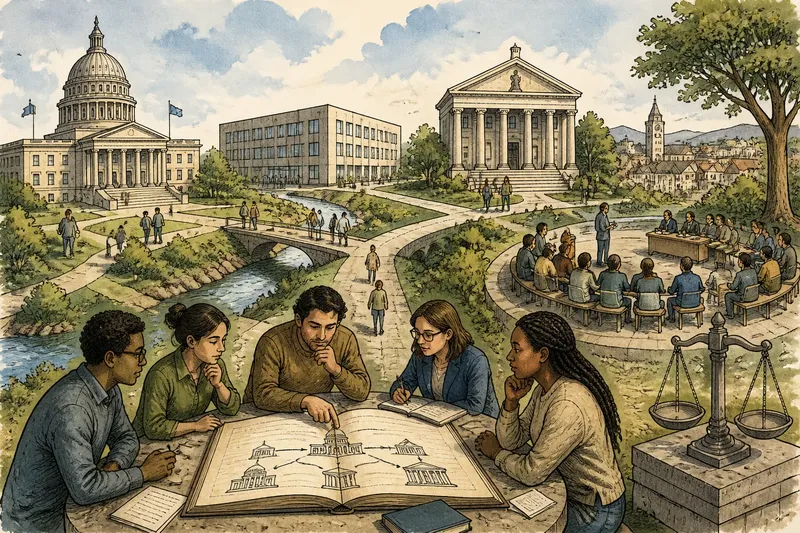
The Long History of the Public Library as a Civic Institution
The history of the public library shows how shared access to books became a civic commitment, and how to tell whether local rules make that promise usable.
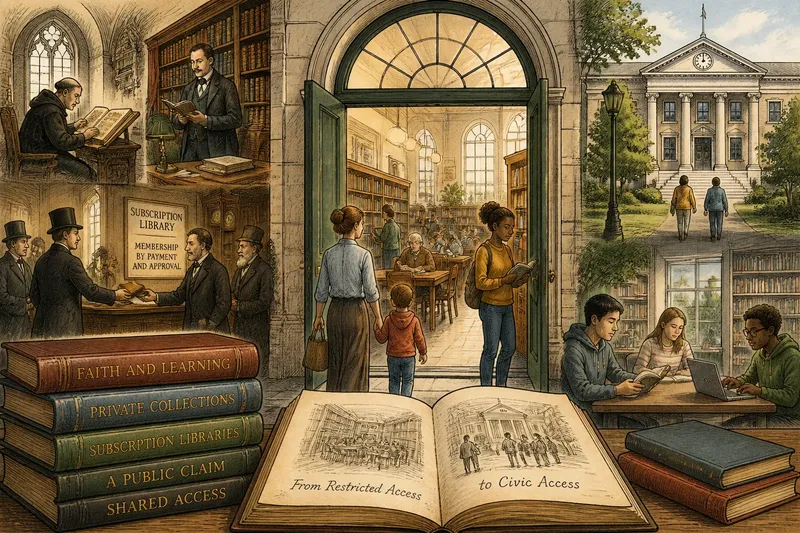
Why should a town support a library that any resident can use, rather than leave books to private collections or commercial sellers? The history of the public library traces changing answers to that question, from restricted collections to a civic claim of shared access to knowledge. That change was uneven: a library’s public purpose has always depended on who could actually use it.
Public responsibility distinguishes a library from a collection
A collection becomes a civic institution not simply because it contains books, but because a community accepts some responsibility for maintaining access to them. That responsibility may take the form of public funding, local governance, open borrowing rules or a combination of these. The details vary, but the underlying idea is that access to knowledge should not depend only on owning books or belonging to a privileged circle.
For much of history, libraries existed without being public in this sense. Religious bodies, rulers, universities and wealthy households assembled collections for their own purposes. Some allowed visitors or scholars to consult books, but admission could depend on status, sponsorship, occupation or personal connections. A collection might serve a wider intellectual community while remaining out of reach for most residents.
The long transition was not a single event, and public libraries did not replace every other kind. Instead, communities changed their answers to three practical questions: who could enter, what access cost, and who would maintain the collection.
Permission shaped access to private collections
When books were scarce and costly to produce, holding a collection meant holding influence. Religious libraries preserved texts for worship and learning; universities gathered works for teaching; private libraries reflected their owners’ interests and means. These collections could support scholarship and preserve knowledge without promising access to everyone nearby.
Access often depended on mediation. A reader might need an introduction, a recognised purpose or the goodwill of the person in charge. Even when a collection was nominally open to visitors, its hours, rules and social expectations could make the invitation difficult to use. Being allowed to request a book was not the same as having an established civic entitlement to consult or borrow it.
Subscription libraries, reading societies and mutual improvement groups offered another arrangement. Members pooled resources and exchanged books, widening access for those able to join and contribute. Membership still drew a boundary, but these groups showed that readers could organise shared provision themselves.
Subscription libraries pooled resources but set a boundary
Members of subscription institutions could contribute money, select books and manage rules together. This made a library more than a private shelf, while keeping its benefits conditional on joining, paying or meeting the group’s expectations.
The model could suit residents who wanted a durable collection and had the means to support one together. It was less accessible to people excluded by cost, status or custom. A broader civic claim asked whether library use should depend on a person’s ability to buy into the institution.
There was no single answer across towns. Institutions often combined public support with private gifts, charitable contributions or membership arrangements. Over time, the claim that a library ought to serve people beyond its donors and members became more prominent.
Public support recast access as a shared concern
As civic authorities and reformers increasingly treated education and reading as matters of common concern, the case for publicly supported libraries gained force. The argument was not just that books benefited individual readers. A library could help residents learn, encounter ideas beyond their households and participate in community life. Supporting access became one way a community expressed what residents should be able to do.
Public funding changed the relationship between reader and institution. A library supported through civic resources could be understood as belonging to the community in a way a private or subscription collection did not. A reader need not arrive as an owner’s guest or a paying member; the institution could define its purpose as service to residents generally.
That principle did not put itself into practice. Local authorities still had to choose where to place a library, what hours to keep, which materials to acquire and how to set rules. A building might be officially open but far from some neighbourhoods; rules might sound neutral yet have uneven effects. The history of public libraries is also a history of the gap between declaring access and making it usable.
Compare library models by who can use them and who maintains them
The word “public” can conceal important differences. A library may receive public support but limit borrowing, or welcome visitors while restricting which materials they can take home. A community collection may be open to all yet depend on donors and volunteers. Look beyond the name to the service a resident can actually use.
- Private collection: Check who controls entry. If access depends on an owner’s permission, then treat public use as conditional; if the collection has a stated open-access policy, then check its hours and limits before relying on it.
- Subscription library: Check whether membership requires payment or approval. If it does, then access is limited to those who can join; if it does not, then check whether other membership rules still restrict use.
- Charitable or community library: Check who funds and staffs the service. If provision depends on donations or volunteers, then ask what happens when support is unavailable; if it has stable local backing, then check who sets its access rules.
- Municipal public library: Check the local authority’s service rules. If residents can enter but need registration to borrow, then distinguish browsing access from borrowing access; if registration is open, then check what documents and materials the rules accept.
- Specialist or university library: Check whether non-members may enter or consult the collection. If use is limited to students or researchers, then seek another service for general borrowing; if visitors are admitted, then check whether advance permission or supervised use is required.
- Local branch access: Check opening times, location and available formats. If the branch is difficult to reach or closed when residents are free, then look for a mobile, digital or neighbouring service; if it is accessible, then check whether its collection meets the reader’s needs.
These are broad distinctions, not sealed historical stages. One institution can combine several models, and its character can change as funding and rules change. What matters is how its arrangements distribute access and responsibility.
Local rules show whether public access works in practice
Check the ordinary points where access becomes real: whether entry is open, whether borrowing requires registration, which identification is accepted, whether fees apply, and which materials can leave the building. Also look at opening hours, accessible formats, language resources and the location of branches. These details show how an institution turns a general promise into a service people can use.
Say a resident has recently moved to a town and wants a language-learning book. They check the library’s registration page and learn that a local address is accepted, but that borrowing requires proof of address. The resident brings a tenancy letter, asks staff to confirm it meets the rule, then registers and borrows the book if it does. If the letter is not accepted, the resident can ask which alternative documents qualify or use the book in the library while sorting out registration. The starting point, each action and the result are clear: entry alone does not settle whether borrowing is accessible.
It is not worth ranking every library by one measure of openness. A small specialist collection may serve its intended public well, while a municipal branch has a broader remit and different constraints. Focus on the stated purpose, the people included, the barriers created by rules and the process for asking questions or proposing change.
What readers ask about the history of public libraries?
Were early libraries open to everyone?
No single answer fits every collection, but many were controlled by religious institutions, universities, rulers or private owners. Some admitted visitors, yet access could depend on status, permission or a recognised reason for reading.
How did subscription libraries differ from public libraries?
Subscription libraries pooled member contributions and served people who joined under the group’s rules. A public library rests on a broader civic responsibility to serve the public, although practical access rules still vary.
Did public libraries replace private collections?
No. Private, university, religious, specialist and community collections continued alongside municipal libraries. The change was the growing presence of institutions intended to serve residents beyond their owners or members.
What made a library genuinely civic?
A civic character came from shared responsibility and an expectation of public access, not from shelves alone. Funding, governance, location, rules and the treatment of residents shaped how fully that expectation was met.
Public access depends on the rules residents can use
The history of the public library is not a smooth march from exclusion to universal welcome. It records competing arrangements: private stewardship, membership, charity and public responsibility, often overlapping in one place. Each answered differently who could read, who bore the cost and who controlled the collection.
The lasting civic idea is that access to knowledge can be organised as a shared responsibility rather than left solely to private ownership or individual means. The history of the public library makes that idea clearer, but local rules give it substance. When you use a library, ask not only what it holds, but who maintains the doors, who sets the terms and which residents those terms recognise.