A Reader’s Map for Following a Public Consultation
Read a public consultation document with confidence: find the decision, identify whose views are sought and see what happens after responses close.
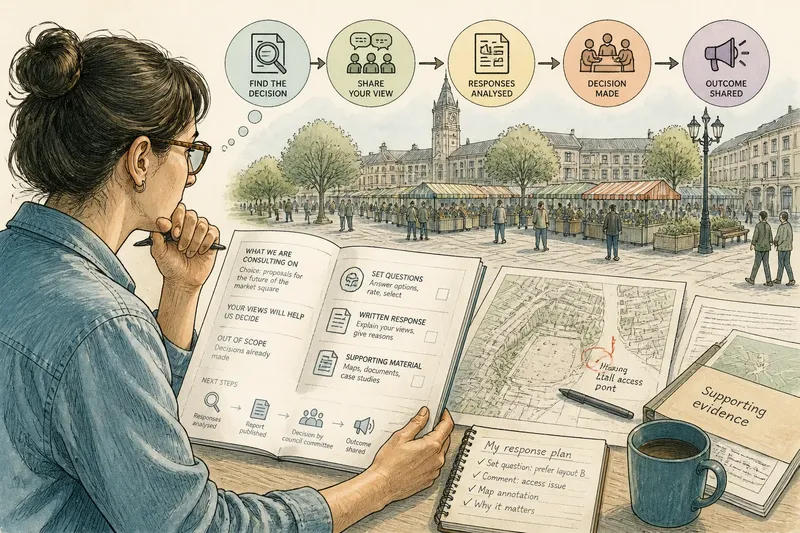
What is this consultation asking you to help decide? A public consultation document should make that question clear, but it may be surrounded by background, options and instructions. To read a public consultation document efficiently, begin by locating the decision it concerns, then compare how it invites views and explains what comes next.
Start with the decision, not the background
Look for an opening section called “Purpose”, “What we are consulting on” or something similar. Find the sentence that names the choice, proposal or problem under consideration. Then check whether the document is asking for views on a specific proposal, a set of alternatives, or the definition of the problem itself.
Those are different invitations. A consultation on a proposed bus route may ask whether the suggested stops meet local needs. Another may ask which areas need a service before any route is drafted. The first is about shaping a particular plan; the second leaves more of the initial design open.
Mark the boundary of the decision. A document may explain that a feature is already fixed, perhaps because of a separate legal duty or an earlier decision. That does not make participation pointless, but it tells you where a response can still be relevant. Look for phrases such as “outside the scope” and “not being considered”.
Compare the ways a consultation frames responses
Most documents use one or more of three approaches. Each gives you a different kind of opening to contribute, and each suits a different reader.
Answer set questions when the choices are clear
A questionnaire may ask you to select an option, rate a proposal or respond to a series of prompts. This suits someone who wants to address a defined set of issues in a direct format. Read the choices carefully: if none reflects your view, check whether there is a comment box or another route for explaining why.
Notice whether a question asks for a preference, a reason or information about your circumstances. Those answers serve different purposes. A preference states what you favour; a reason helps explain the basis for that view; local knowledge may identify an effect that the options do not capture.
Write a considered response when context matters
An open written response suits someone whose point needs explanation, or whose concern does not fit neatly into a multiple-choice question. Use the document’s prompts as signposts: connect each point to the issue being considered, give a relevant reason and state what change or clarification you are asking decision-makers to consider.
Keep the response focused. A long account of a related frustration can obscure a useful observation if the link to the consultation’s question is not clear. You can briefly explain the connection, then make the point itself.
Use a supporting format when the issue is local or detailed
Some consultations invite supporting material, such as a map annotation, a short case description or a response from an organisation. This can suit people who need to show where a proposed change has an effect or to bring together knowledge shared across a group. Check that the document accepts that format and explains how to submit it; an attachment is useful only if it can be connected to the relevant question.
Say you are reading a council proposal to alter a market square. The questions offer several layouts, but you know that a stall access point is missing from the drawing. You could select the closest layout, explain the access issue in the comment field, and refer to the marked location in an accepted map attachment. The useful result is a response that identifies both your preference and the practical detail behind it.
Choose a response route that fits your point
Before drafting, make a quick choice among the available approaches. Use this comparison:
- Choose set questions when your view corresponds to the options and prompts provided.
- Choose a written response when your reasoning, alternative or qualification needs room.
- Add supporting material when a place, document or shared body of knowledge makes the point clearer, and the consultation accepts it.
- Use more than one route only when each part adds something distinct, rather than repeating the same comment in different boxes.
Look for submission instructions, the closing date, accepted formats and any explanation of how responses will be handled. If the document limits a response to a form, follow that route rather than assuming an email or attachment will be included. Where requirements depend on the consultation’s own rules or local arrangements, use its instructions as the guide.
It is not worth trying to answer every question if only a few relate to your knowledge or concern. A precise response to the relevant prompts is easier to understand than a broad statement that leaves decision-makers guessing which part matters.
Check what the document says happens next
Find the section describing the next stage. It may say that responses will be analysed, published in a report, used to revise a proposal, or considered before a formal decision. These phrases describe different steps, so do not treat “we will consider responses” as a promise that a particular suggestion will be adopted.
Look for who makes the eventual decision and how the public can see what followed. The decision-maker might be a council committee, a public agency or another named body. A document may also explain when an outcome statement or response report will appear, or how to receive updates.
Separate what is stated from what remains unclear. If the consultation explains how it will summarise responses but says little about how those views affect the final choice, note that gap. You can ask for the process to be clarified in your response, provided it relates to the consultation’s scope.
Questions readers often ask before responding?
Does a consultation mean the proposal is undecided?
Not necessarily. The document may leave the main choice open while fixing some details, or it may seek views on a proposal that could still change. Look for explicit statements about what has already been decided and what remains under consideration.
Should I respond if I do not support any listed option?
Check for an “other” choice, a comment box or instructions for a written response. State which aspect fails to address your concern and, if useful, describe an alternative in terms relevant to the question.
Will an individual response count more than a group response?
Do not assume that format alone determines how a response is considered. Check how the consultation says it will handle individual submissions and group material, then make the contribution clear, relevant and easy to attribute as directed.
Keep a simple record of the consultation
Save the consultation document and the confirmation or receipt of your response, if one is provided. Note the consultation name, the closing date and any stated point when the authority expects to publish an update. This gives you a practical reference if you later want to compare the proposal with the account of what happened.
A good public consultation document tells you what is open to influence, what sort of response it needs and how the process is expected to move forward. Read those parts in that order, choose the route that suits your point, and keep the response tied to the decision at hand. That makes your contribution easier to follow—and makes the next stage easier for you to check.